
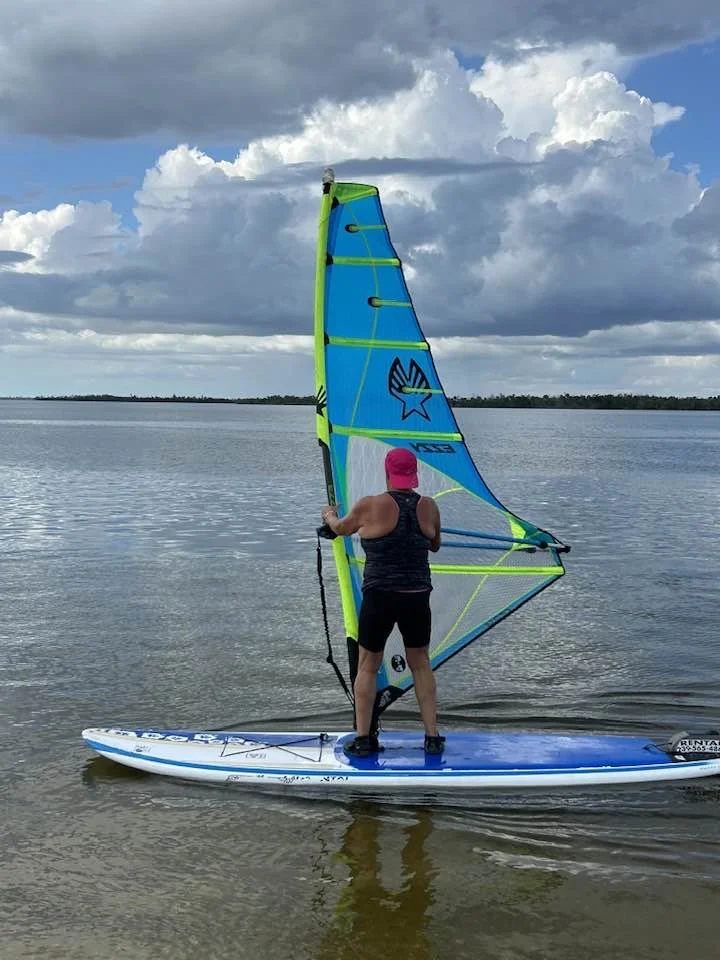
When you attempt to try every sport once in your lifetime, traveling to a sporting destination is essential. I know I have to return to the Arizona desert to try sand surfing, a Caribbean island to do spear fishing, and to Vermont to try mixed ice/rock climbing, so when I returned to Sanibel Island last week, wind surfing was the sport of choice. Kite surfing was going to have to wait until I tried windsurfing at least.
Wind surfing gained popularity in the late 1970s and rose through the 1980s, becoming a mainstream water sport, and was included in the 1984 Los Angeles Olympics as a demonstration sport. When we took our sons to Sanibel Island in the 1990s, we met Rinn Newmeyer, the top Windsurfer in America for three years in a row and a two-time bronze medalist in the World Championships. Rinn was our fishing captain a few times. My sons loved him.
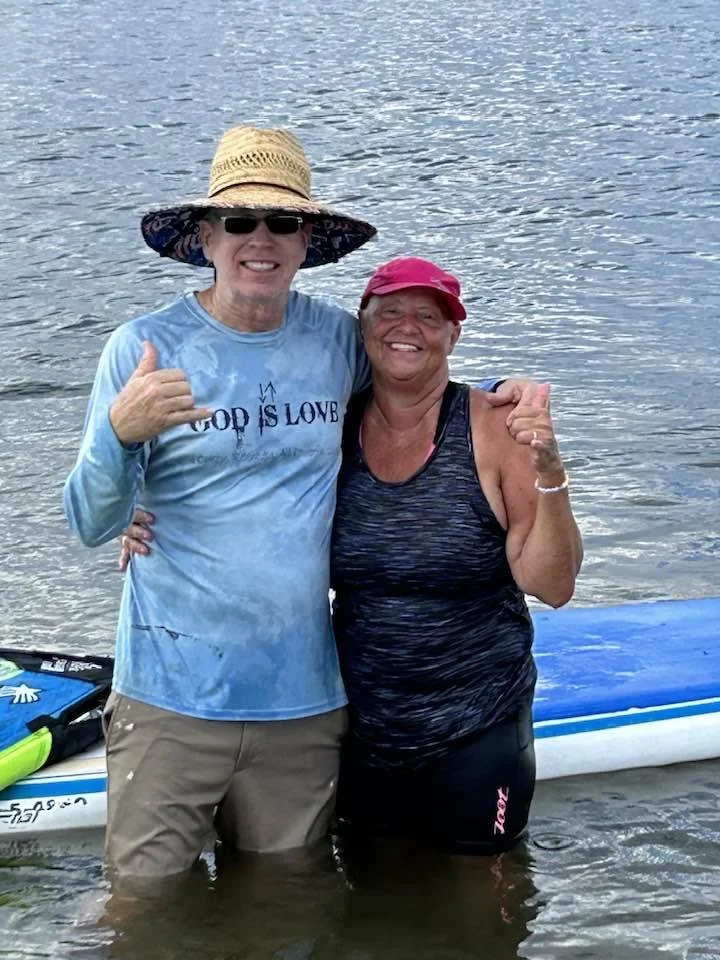
Roy from Ace Performers, Tracy Chamberlain Higginbotham, his student!
But I couldn’t find Rinn to teach me to windsurf this time, but landed on Ace Performers, who met me on the Causeway Islands, the islands that connect the mainland to Sanibel Island. There, the waters were shallow and windy, and if you face planted (which I did numerous times), it was easy to get back up and try again (which I did!)

Tracy first time surfing in Maine - September 2024
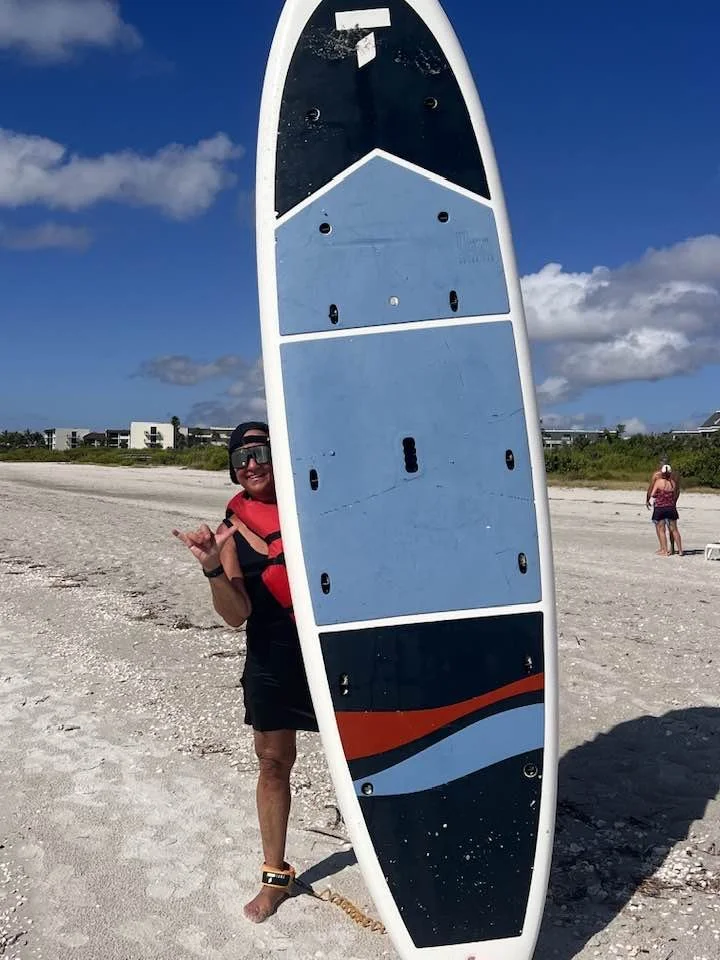
Tracy Chamberlain SUP - Sanibel Island, Florida 2025
If you have tried Stand Up Paddle Boarding, Surfing, and Sailing, windsurfing is a combination of all three, in my opinion. The windsurfing board was as wide as the SUP board and the beginner’s surfing boards I tried in Maine and California, and adjusting the mast to the wind to change directions was like sunfishing/sailfishing on Lake Delta when I was a teenager. You need to have balance, core strength, and a bit of courage to sail on the waters, no matter what sport.
I wasn’t surprised. I wasn’t nearly as stable on the surfboard as I was a year ago, because I haven’t been on one since then. I wish I had because I would have had a better sense of bending my knees, greater confidence, and been able to avoid overreacting to changes in waves or wind. But I got on board with my coach’s instructions, as he held the boat and glided me along until I got my sea legs under me.
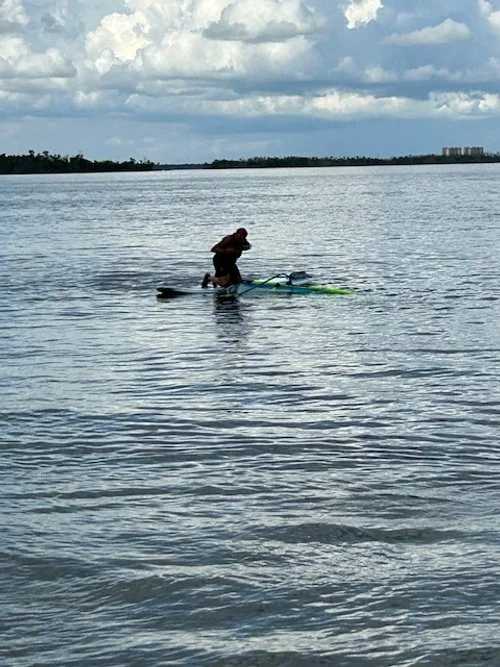
Tracy faceplanting and getting up anyway to windsurf again.
The trickiest part was staying balanced, reaching over at a 90-degree angle to grab the rope attached to the mast, and pulling the sail full of water up without falling backward due to the pull. Of course, I fell at least 4 times, but who cares if you face plant in 80-degree water? My coach told me you got 96 more falls in this lesson, that’s how often beginners fall until they understand how to balance while windsurfing.
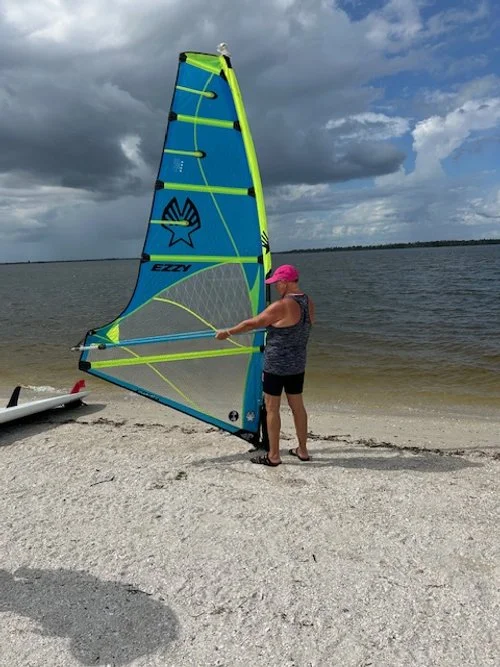
The heavy, clear plastic sail popped in and out depending on the wind direction and gust speed, which sets you “surfing”; the waves play some part in it, but the wind is the main element you need to surf, aka “sail”, and move across the tops of the water. When you have to change direction (tacking), you maneuver your feet first, then arms, around the mast pole, then allow the sail to change directions and “pop” into its new position. Facing into or away from the wind sets your speed.

It was only an hour lesson, but a great one for getting a salty taste of this new sport. I would definitely try it again. I spent the rest of the vacation on a Stand-Up paddleboard, riding the higher waves across the light green waters of Sanibel Island without falling in. It would have been helpful if I had tried windsurfing one more time before I left. But for now, I’ll add another sport I attempted to my list. I will book it again when I’m in the tropics, and encourage you to try it, especially if you love warm, salty water, the wind at your back, and palm trees dotting the shore.
Note: Have you ever tried windsurfing?
